
The Music Promo Guide: why no one opens your promos, and how to fix it
Six ways a music promo dies: deliverability, targeting, friction, silence, list rot and leak fear. The fix ladder for labels, plus etiquette that works.
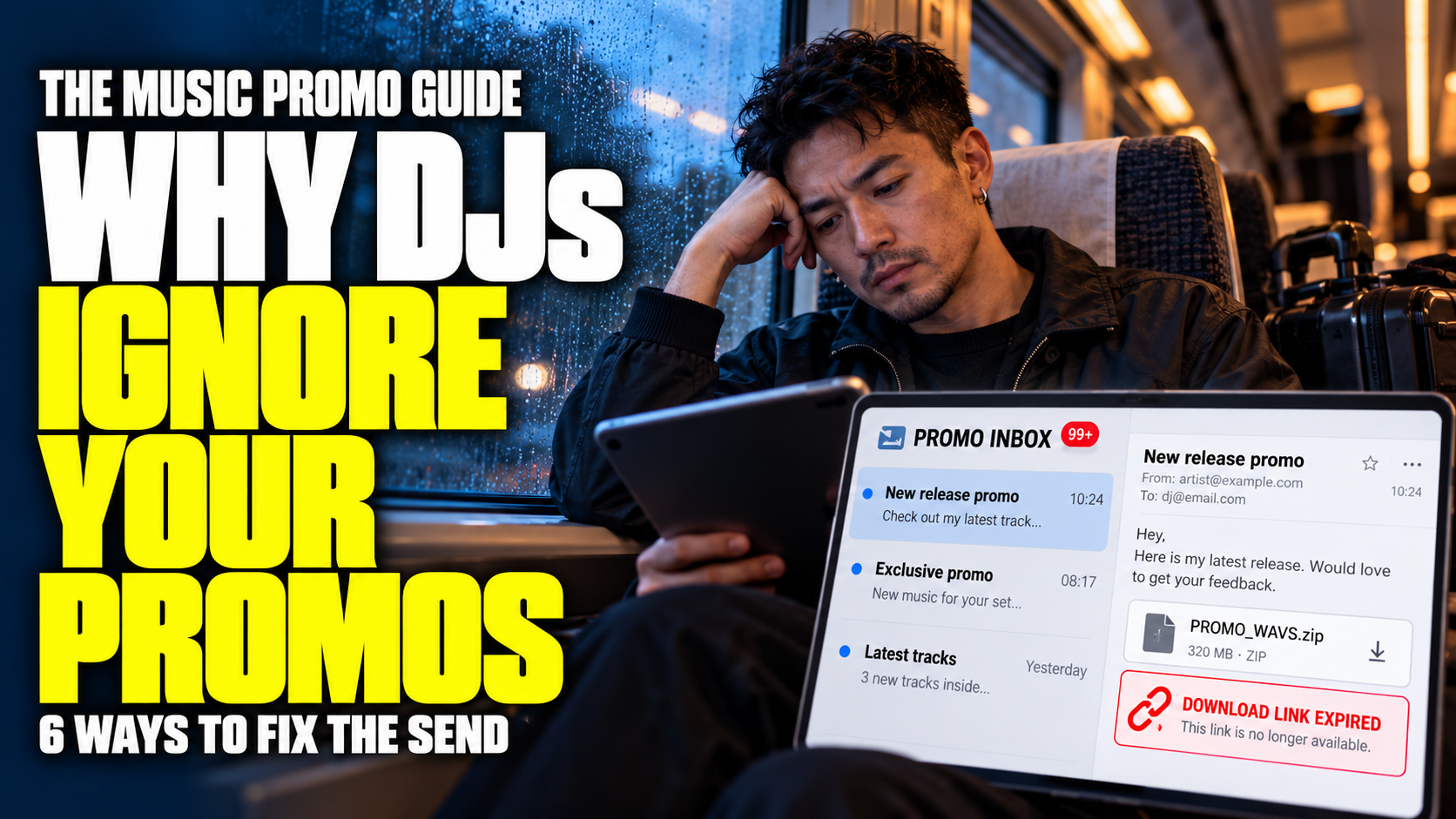
TL;DR
- Most promos die before the music is judged: at the inbox (unauthenticated sending, blast-shaped emails), at the click (attachment dumps, expired transfer links), or in silence (no tracking, so support looks identical to indifference).
- BCC-ing 200 DJs from a personal Gmail account is how spam filters learn your name. Send from your own authenticated domain, at a steady volume, to people who asked to be there. For a UK DJ trading on their own account, that is also the law.
- Make the promo effortless: stream first, right-format download one click away. Every extra step costs listeners who wanted to play the record.
- Track opens, plays, downloads and feedback per recipient, or your best supporters and your dead weight stay indistinguishable.
- Promo lists rot as inboxes and jobs change. Give new supporters a public way to apply, and retire addresses that never engage.
- Etiquette is a strategy: send club promos roughly 4 to 6 weeks ahead and radio 6 to 8, state your embargo clearly, chase once at most, and thank the people who play your records.
Why does promo servicing still matter?
Promo servicing is the practice of privately sending unreleased music to DJs, radio, press and curators before the public release, in exchange for plays, coverage and honest feedback. It is the oldest growth channel in music, and per recipient still one of the strongest, because every member of that small audience is a multiplier.
Spotify pays roughly $0.003 to $0.005 per stream, a commonly reported range rather than a published rate, which is 200 to 333 streams to earn a dollar. One DJ playing your record to a full room, or one specialist radio play, reaches more of the right people than thousands of anonymous streams, and it compounds into Shazams, playlist adds and listeners who stay.
Which is why it hurts that most promo campaigns are quietly dead on arrival: not because the music is wrong, but because the send is. This guide is the autopsy: six ways a promo dies, then the repairs in order of impact. The companion piece, The Label Promo Playbook, builds the whole servicing operation; this one fixes the send itself.
The autopsy: six ways your promo died
Promos fail at one of six specific points. Work through them in order: each failure hides the ones behind it, and you cannot diagnose weak targeting on a promo that never reached an inbox.
Failure 1: it never arrived
If your promos go out as a BCC blast from a personal Gmail or Outlook address, part of every send never reaches an inbox, and you cannot tell which part. Personal accounts are built for person-to-person mail (Gmail locks one out of sending for up to a day after 500 recipients on a single email, or 500 emails in a day), and one identical message to 200 strangers looks exactly like spam to a mail provider, because structurally it is.
The rules are now explicit. Since February 2024, Gmail and Yahoo have required every sender to authenticate their domain and keep spam complaints under 0.3%, and Gmail adds stricter rules once you send close to 5,000 a day to personal Gmail addresses. Fall short and your mail can be refused, which at least bounces, or quietly filed as spam, which nobody tells you about. Your open rate just decays, and you blame the music.
The cruellest part: mail providers score senders on engagement history, so a list full of dead addresses teaches the filters your mail is unwanted and drags delivery down for the recipients who do care.
Failure 2: it arrived, but meant nothing
The recipient can smell a blast from the first line. "Please find attached our latest release", addressed to nobody, about a genre they do not play, is not a promo. It is noise with a tracklist.
The DJs and press worth reaching are triaging a full inbox, fast. A techno promo sent to a drum and bass DJ does not just get ignored, it recategorises you: this label does not know who I am, so nothing they send is worth opening. Wrong-genre sends convert warm contacts into permanent skips, and enough of them nudge people towards the spam button, which feeds Failure 1.
Failure 3: it arrived, but was work to use
A promo that arrives as six WAV attachments, or a transfer link that expired last Tuesday, demands labour before a note is heard. Download the zip, unpack it, find it again weeks later on the DJ laptop, after the link has died and the moment has passed. Every step between "opened the email" and "heard the music" loses listeners who liked you enough to click but not enough to work for it.
Failure 4: they played it, and you never knew
This is the quiet one, and arguably the most expensive. Without per-recipient tracking and a feedback path, a DJ who downloaded your last four records and played them all weekend looks identical to an address that has ignored you for a year. So you treat them identically.
What you are losing is not just data, it is the relationship. Supporters want to be seen supporting. Give them a way to show up, and you get pull quotes, plays to cite and a truthful picture of your record's real champions.
Failure 5: the list itself is dead
Promo lists rot. People change jobs, kill inboxes, stop DJing, move genres. A list built five years ago and never pruned is mostly ghosts, and (see Failure 1) ghosts actively harm delivery to the living.
The rot has a partner problem: no way in. If the only route onto your list is knowing you personally, the list ages with your address book, and the new DJs, shows and blogs hungriest to champion new music have no door to knock on. A living list needs an exit (retire addresses that never engage) and an entrance (a public application route you review).
Failure 6: fear limited what you sent
Leak paranoia is rational: an unreleased record circulating early can wreck a release plan. So many labels service only a tiny circle of trusted names, weeks late, streaming-only. The B-list, the up-and-comers, the new radio show that would have rinsed it get nothing until release day, when their support is worth least.
Forensic watermarking dissolves this trade-off: every recipient's copy carries an inaudible mark unique to them (how it works is below). Its real effect is behavioural, not detective work: a recipient who knows their copy is identifiable simply does not pass it on. The deterrent does more than the tracing ever will, and it lets you service a wider circle earlier, which is where promo campaigns are won.
How promo delivery and tracking actually work
These mechanics decide whether a promo is delivered, measured and safe, and most promo advice skips them.
Sender authentication, in plain words. SPF, DKIM and DMARC are three records on your domain's DNS that together prove an email claiming to be from you really was sent by you. Gmail and Yahoo require SPF or DKIM from every sender; Gmail makes DMARC and one-click unsubscribe mandatory once you send close to 5,000 a day to personal Gmail addresses. A 200-person promo list is nowhere near that line, which is why the rule that actually bites a label is the next one. Any serious email system sets all three records up once, during domain verification, and they simply work.
The complaint threshold is smaller than it sounds. Every sender has to keep spam complaints under 0.3%: 3 per 1,000 emails. On a 200-person list, one annoyed recipient hitting "report spam" puts you at 0.5%, over the line. Consent and relevance are deliverability strategies, not just manners: the person who never asked to be on your list is the one who files the complaint.
Consent is also the law. A DJ trading on their own account is a sole trader, and PECR treats a sole trader like any individual, so emailing them your release needs their consent. The exemption for businesses covers limited companies, such as a radio station's own addresses, not a DJ's personal inbox. The United States version. CAN-SPAM asks for no prior consent, but a commercial email must carry your physical postal address and honour an opt-out within 10 business days, and a promo for a record about to go on sale is safest treated as commercial.
Volume patterns matter. A domain that sends nothing for two months and then fires 300 identical emails in a minute fits the fingerprint of a compromised account. Steady, moderate, engaged-with sending builds the reputation that gets your release-week send delivered.
Opens are directional, plays are real. Apple Mail Privacy Protection (2021) pre-loads email content, inflating open rates for Apple Mail recipients. Treat opens as a rough signal and what happens on the promo page (plays, downloads, feedback) as the truth. Stream-first pages also move your measurement from the least reliable metric to the most reliable ones.
How forensic watermarking traces a leak. A forensic watermark is a per-recipient signature embedded in the audio itself, inaudible to the listener and unique to each person you service. If a watermarked file surfaces on a filesharing forum, reading the watermark identifies whose copy it was. Nobody is accused in advance: you tell everyone the promos are watermarked, and let that do the work.
The playbook: fix your promos in order of impact
Repair in this order. Each step multiplies the value of the ones after it.
1. Fix the sender. Send from your own authenticated domain through a proper sending system, never a personal-account BCC. Include a working opt-out in every promo and keep volume steady. This step alone often revives a "dead" list: some of those people never stopped caring, they just stopped receiving.
2. Fix the targeting. Split your list by genre and role (DJ, radio, press, curator) and send only what fits. The fix is not 200 bespoke emails: it is one honest personal line at the top for the handful who matter most. "Thought of your Rinse show for track 2" takes fifteen seconds and changes how the next thirty go. If you cannot say why someone is getting this record, they should not be getting it.
3. Fix the delivery. Move to a private stream-first promo page: play in one click, download in one more, in the format each recipient type wants (WAV for DJs, MP3 for press, FLAC for the audiophile end of radio), with no links that expire while the campaign is live. Put the tracklist, artwork and pitch on the page so the email can stay short. Then stop relying on the email alone for your A-list: plenty of DJs now pull promos through pool apps that plug into rekordbox, and a personal message gets read before the promo inbox does. Send your top twenty the link personally too, one line on the channel each one uses. The page is still where the plays and the feedback land.
4. Fix the feedback loop. Ask small: a star rating, an optional one-line quote, a "will you support this?" tick. Add a proof-of-play route (a clip of the track in a set, a link to the radio rip) so supporters can show you the record working. Then close the loop: read it, use the quotes, thank people by name.
5. Fix the list. Open a public application route so new DJs, shows and writers can ask to join, with you approving each one. Quarterly, retire addresses with six months or more of zero engagement. A 60-person list that listens beats a 600-person list that does not.
6. Fix the fear. If leak fear stops you servicing wider and earlier, watermark, then widen the early circle deliberately: a B-list DJ with a watermarked copy four weeks out is worth more than the same DJ hearing it on release day.
The workbook: The PDF adds a six-failure diagnostic for your last campaign, a sender setup sheet, a genre and role targeting grid, a lead-time planner, embargo and chaser wording, and a quarterly list clean. Free for an email address.
Shortcut: SoundOps does steps 1 to 4 out of the box on every plan, gives step 5 its public application pages and a sort by last activity to find the dormant, and adds watermarking from the Business plan up.
And the etiquette that keeps you welcome. Promo is a relationship channel wearing a broadcast costume, so behave like a guest:
- Lead time. Service club promos roughly 4 to 6 weeks before release and radio 6 to 8, because shows plan further out, and in the UK register the recordings with PPL before radio gets them: PPL can only pay out on airplay it can match to a registered recording. A promo landing three days before release is a press release, not a promo.
- Embargoes. An embargo is the date before which the recipient may not publicly play, post or review the music. State it plainly on the page and in the email. Most people respect a clear embargo; almost nobody respects an implied one.
- Chase once, at most. One polite nudge is fine: three to seven days later, to the people with no sign of a listen. A second is pressure. A third is an unsubscribe.
- Say thank you. When someone plays, reviews or charts your record, acknowledge it personally. Labels with devoted promo pools treat support as a favour, because it is one.
- Respect preferences. If someone asks for MP3 only, or one email a month, or drum and bass only, honour it forever. Every respected preference is a complaint that never happens.
Doing it in SoundOps
You can assemble all of this from a mailing tool, a file host and a spreadsheet. SoundOps ships it as one system on every plan, mapped here failure by failure.
The send (failure 1). Promos go out from your own verified domain, with an opt-out link in every one. Your promo pool is stored and metered apart from your fan CRM: industry contacts never receive your fan marketing, and a 30-DJ campaign counts as 30 promo recipients and touches nothing else.
The page (failures 3 and 4). Each recipient gets their own private page: stream in the browser, download in the formats you allow (WAV, MP3, FLAC, AIFF), with the artwork, tracklist, pitch and press kit alongside. Because every page is individual, you see opens, plays and downloads per person and per track, not one blurred number. Only the audio counts as a download: a press kit, ZIP or artwork file is logged on its own, so it never makes a recipient look engaged.
Feedback and proof of play (failure 4). Recipients rate the release (per track on a multi-track promo), leave a quote you can lift for press, tick a support level, and come back later to add proof of play, up to five items per campaign: a set clip, a Spotify support link, a story URL. You can lock downloads until they have rated; streaming always stays open, because nobody can rate a record they cannot hear.
Tiers (failures 2 and 5). Once you have serviced a contact, they carry an A, B or C tier, derived from their engagement or pinned by you. Big sends deliver the A-list first, and a VIP toggle restricts a campaign to A (or A and B) for the early exclusive window. When a C-tier contact claims support, you get a one-click prompt to promote them; the judgement stays yours.
The list (failure 5). Any promo list can open an application page at /apply/your-name, where DJs, press, radio and music supervisors apply with their role, outlet, genres and sample work. Contacts also take your own free-form tags, which segments can filter on. Applications land in a review queue, or approve themselves when an applicant's past engagement speaks for them. To retire the dormant, sort your contacts by last activity and remove them from the list in one batch action. The QR version of the application page belongs on the back of the booth.
The one chaser (the etiquette). Flip a toggle and the people who never opened, opened but never played or downloaded, or left no feedback get one follow-up after a delay you pick, from a day to two weeks. It is capped at one per campaign, so the polite nudge can never become the third email that gets you unsubscribed.
Watermarking (failure 6, Business plan and above). Turn it on per campaign and each recipient's audio carries an inaudible signature unique to them, so a leaked file traces to exactly one inbox. Campaign analytics also flag suspicious patterns, such as one link opening from several cities, for you to judge. Nothing is revoked automatically, because a touring DJ can look like a leak and is not one.
The Promo Network (Growth plan and above). Push a campaign to other labels running submission inboxes on the SoundOps Promo Network: it lands in each inbox whose genres match yours as a single submission carrying your pitch and press kit, and their rating and feedback sync back to your analytics. No email addresses change hands between accounts. What it buys you is a listen from a label you are not in touch with yet. It does not email their DJ or press list, and whether your record travels further is their call.
A dedicated promo servicing tool is usually a subscription of its own; in SoundOps it is included on every plan, from £19 a month, with a 14-day free trial on Starter.
How it connects
Promo servicing is one loop with the rest of your operation. Your demo submission inboxes are a promo-list goldmine: everyone submitting music to you is a working DJ or producer in your genre, and the Promo Network runs on exactly that connection. Promo sends live under the same deliverability roof as fan campaigns, so the sender-reputation fundamentals in the email guide protect both. Keeping industry contacts separate from fans while tracking each relationship properly is the heart of the music CRM guide. If the record leans on a sample, read the sample clearance guide before it goes out, because a promo already puts copies in circulation. And when you are ready to build the whole servicing operation, the full blueprint is The Label Promo Playbook.
The condensed checklist
The sender
- Sending from your own authenticated domain (SPF, DKIM, DMARC), never a personal BCC
- Working opt-out link in every promo email
- Steady sending rhythm, no month-long silences then a blast
The send
- List segmented by genre and role; nothing sent outside a lane
- Personal top line for your most important recipients
- A-list also sent the link personally, on the channel they read
- Club promos out roughly 4 to 6 weeks ahead; radio 6 to 8, recordings registered with PPL first
- Embargo date stated plainly on the page and in the email
The page
- Stream-first: play in one click, download in one more
- Right formats per recipient type (WAV for DJs, MP3 for press)
- No links that expire while the campaign is live
- Feedback asks kept small: rating, quote, support tick, favourite track
- Proof-of-play route for supporters to show the record working
The list
- Everyone on the list asked to be there; nothing bought or scraped
- Public application route, with every applicant reviewed
- Contacts tiered A/B/C by real engagement
- Addresses with 6+ months of zero engagement retired quarterly
- Format and frequency preferences honoured without exception
The follow-through
- One chaser, maximum, to anyone with no sign of a listen
- Quotes harvested for press use
- Supporters thanked by name
- Watermarking on if leak fear is limiting who you service early
Frequently asked questions
Why does no one open my promos?
Usually one of three reasons, in order: they never received it (unauthenticated or personal-account sending got it filtered), it was not relevant (wrong genre or an obvious blast), or the address is dead. Fix delivery first, then targeting, then prune, because each problem hides the ones behind it.
How long before release should I send a promo?
Roughly 4 to 6 weeks before release for club promos and 6 to 8 for radio, where shows plan further ahead. Trusted A-list first, then widen. A promo arriving days before release leaves no time to use it.
How many people should be on a promo list?
As many as you can justify one by one; there is no published benchmark. What matters is the share who play, rate and reply: a small list that engages beats a big silent one, and protects your sender reputation too.
What format should I send promos in?
Stream-first, with downloads in the format each recipient type wants: WAV for DJs, MP3 for press, FLAC for audiophile radio. Attachment dumps and expiring links are the fastest ways to lose someone who wanted to play the record.
Why do my promo emails go to spam?
Most commonly: unauthenticated or personal-account sending, spiky volume, stale addresses dragging engagement down, or complaints from people who never asked to be there. Since February 2024, Gmail and Yahoo have required every sender to authenticate their domain and keep spam complaints under 0.3%, just 3 in 1,000, so on a 200-person list one complaint is enough to cross the line.
What is forensic watermarking on a promo?
An inaudible signature embedded in each recipient's copy of the audio, unique to them, so a leaked file traces back to exactly one inbox. Its main value is deterrence: recipients who know their copy is identifiable do not share it, which lets you service more people earlier.
Should I chase DJs who did not open the promo?
Once, politely, three to seven days after the send, to the people with no sign of a listen. More than one reads as pressure and invites unsubscribes and spam complaints.
How do I grow a promo list without buying one?
Never buy one. The people on it have not consented, which in the UK makes emailing any sole-trader DJ on it unlawful under PECR, and their complaints will wreck your deliverability. Open a public application page and put it everywhere your scene looks (bio links, release posts, the booth), mine your demo submissions for active DJs in your genre, and convert real-world relationships into list places.
Should promo contacts be on my fan mailing list?
No. Different purpose, different consent, different content. Mixing them means industry contacts get fan marketing they never asked for, which is a spam complaint waiting to happen. Keep the promo pool separate from the fan CRM.
Know someone who needs this?
Send them the guide. It is free to read, no signup needed.