
The Label Promo Playbook: know who listened, who played, who leaked
Build a tiered DJ promo pool, service it with per-recipient links instead of attachments, watermark the audio so a leak traces to one name, and turn DJ feedback into press assets. Six steps, a campaign timeline and copy-paste templates.
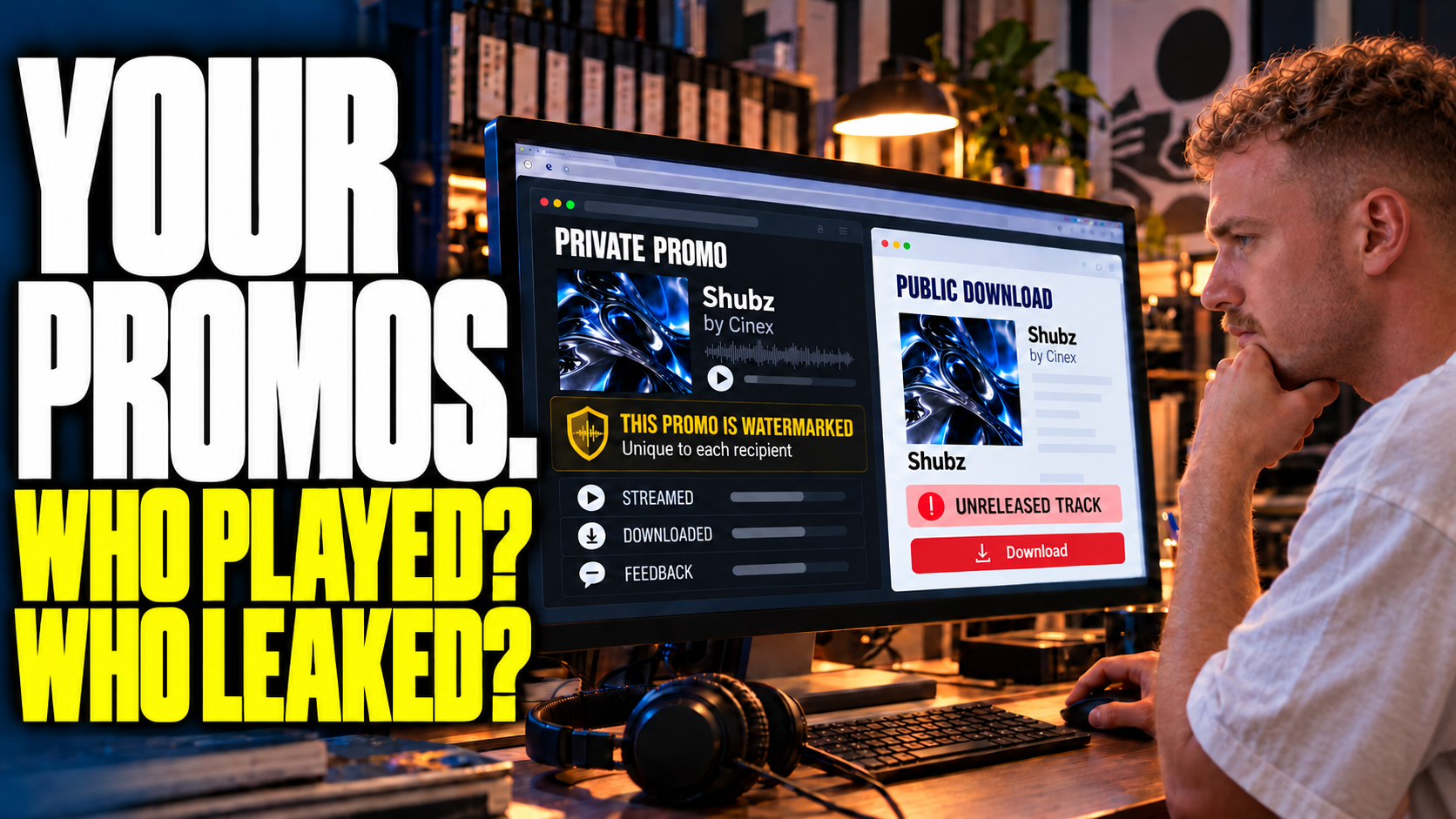
TL;DR
- Promo servicing means sending unreleased music privately to DJs, radio and press before release. For most dance and electronic labels it's the highest-leverage marketing they do. In 2025, 106,000 tracks a day landed on streaming and 88% took 1,000 streams or fewer (Luminate). The right 30 DJs beat 30,000 impressions.
- Most labels run it on a mail merge, WeTransfer links and a spreadsheet that rots: leaks with no trace, no structured feedback, no idea who played anything.
- Build the pool deliberately. Tier A/B/C on measured engagement, vet every new name, and open a public application page that doubles as your consent record.
- Service with per-recipient links, never attachments, and score people on what they streamed and downloaded. Apple Mail pre-fetches the pixel, so a lot of your "opens" are machines. Watermark the audio so a leaked copy traces back to one name.
- Every campaign should come back with ratings, quotes, support claims and proof of play. The quote goes on your one-sheet, the support claim tells you who to promote, and some of the proof you can look up instead of asking for it.
- One chaser, then stop. After every campaign: promote, demote, prune. Count back from release day: club 4 to 6 weeks, radio 6 to 8, print 12 or more. Deliver at least 7 days out for Spotify's editors and pitch before the song goes live, because Spotify won't take a pitch after (Deezer and Amazon take them up to 14 days after release).
The problem: your best channel runs on your worst tooling
In 2025, 106,000 tracks a day were uploaded to streaming, up 7% on the year before, and 88% of all tracks took 1,000 streams or fewer across the year (Luminate 2025 Year-End Music Report). Your next release is one of that day's 106,000. Posting about it barely registers at that scale. Median Instagram engagement is now 0.30% of followers per post, down from 0.36% the year before (Rival IQ). What still works is one respected DJ playing the record in a full room, one specialist producer scheduling it, one writer whose readers are your buyers. That's where a small label out-punches a major.
If the music went out last time as an attachment or an open WeTransfer link, every name on that list got a byte-identical file, and that costs you twice. When the record surfaces on a forum three weeks early, every copy looks like every other, so you have 150 suspects and no way to narrow them. And because no copy was ever distinct, the campaign teaches you nothing. You know who replied. That's it.
The eight-point self-audit
Tick what describes your last promo run.
- The files were attached. No access control, no expiry, no trace.
- Everyone got the same email at the same time. Your best supporter handled like the address that has never opened one.
- The list has not been cleaned in living memory. Around 23% of email addresses go bad every year (ZeroBounce's own sample, so treat it as an upper bound), and a promo pool is mostly work addresses, which churn hardest.
- Feedback meant "reply if you like it". No record of who said what about which track.
- You have no idea who actually played anything. Support claims are lovely. Evidence is better.
- When it leaked, you had nothing. No per-recipient copies, no watermark, no access log.
- You either never followed up or you barraged. Both waste the send. One burns the relationship as well.
- Your promo contacts live on your fan list. A radio producer doesn't want your merch newsletter, and mixing the two muddles your data and your legal position.
None of this makes you bad at your job. It's what happens when a high-stakes workflow grows up inside tools built for something else.
Why listen to us
We build the platform independent labels run their promos, release marketing and fan CRM on, so we see which campaigns come back with support claims and which come back with silence. Every step below works on a mail merge, a file host and a spreadsheet. At SoundOps it's all built into one subscription, under one roof.
The system
Six steps. Each one works on its own. Run them together and they compound.
1. Who actually belongs on a DJ promo pool?
A promo pool is the curated list of DJs, radio and press contacts a label services with unreleased music. The key word is curated. Most independent labels service between 20 and 200 contacts per release. Past a couple of hundred, a pool stops being a pool and becomes a broadcast, and broadcasts leak.
Someone belongs if they pass one of three tests. Reach: a club residency, a radio show, a mix series, a playlist with a real audience, a publication your buyers read. Taste: a drum and bass tastemaker on a deep house pool is dead weight for both of you. Engagement: they listen, they download, they occasionally reply, and all three are measurable.
Then tier it on what people did rather than how well you remember them, reading the last few campaigns' streams, downloads, feedback and support claims:
- A-list (roughly your top 20%): consistent supporters and genuine tastemakers. The record first, sometimes exclusively, in the best formats, with a personal note.
- B-list (the next 30%): regular engagers. The wide send in week two.
- C-list (the rest): one or two more campaigns as a courtesy, then pruned.
The critical rule: tiers have to shape send order and access. If your A-list gets the same email, on the same day, with the same access as your C-list, you don't have tiers, you have decorations. Early access is the currency of promo. Spend it on the people who earn it.
Grow the pool by inbound, not just outreach. The best addition to a promo list is someone who asked to be on it. Put a public application form somewhere findable (your site, link-in-bio, release credits, a QR code on the merch table), ask for role, outlet, genres, location and a link to their work, then vet:
- Is the outlet or show real, active and human?
- Does their output match your sound?
- Can you find evidence they support records like yours (tracklists, charts, coverage)?
- Would you be comfortable with this person holding your unreleased audio?
If the answer to the last one is no, the answer to the application is no. Log what each applicant agreed to, when, and which lists it covers: that form is your consent record, and it answers half the legal question below for free.
Shortcut: SoundOps gives every promo list a public application page at /apply/your-slug with a QR code minted for it, so DJs and press apply with their role, outlet and genres and you approve or decline from one screen.
One list they must never be on: your fan list. In the UK, the marketing rules (PECR) let you email a company or public body address on legitimate interests with a clear opt-out. But the ICO counts sole traders and most partnerships as individuals, and that's most of a dance pool: freelance DJs, freelance writers, one-person radio shows. So assume your pool needs consent. The US works the other way round, with no consent required but a working opt-out honoured within ten business days and a postal address on every message, and Canada is stricter than either. The FAQ at the bottom has the detail. The practical rule travels everywhere: separate lists, separate opt-out. (Not legal advice, and current as at September 2026.)
2. Service properly: links, not attachments
The delivery rule is one sentence: send a private streaming link with controlled downloads, never an attachment. An attachment is a copy you no longer control. A link is a door you still hold the key to.
A promo link gives you four things a file never can:
- Access control. The link is unique to the recipient. Gate it, expire it, shut it off.
- Per-recipient tracking. Who streamed, which tracks, who downloaded and in what format: the raw material for your tiers.
- Format discipline. DJs generally want WAV, press are fine with MP3, and a press list that streams without downloading is one less leak surface.
- An embargo that means something. An embargo is an agreed date before which nothing about the release goes public. On an attachment that's a polite request. On a controlled link you can actually enforce it.
The rule survives the channel. Your A-list note might happen in a DM, but the link travels with it and the file never does.
Don't tier on opens. Apple Mail Privacy Protection pre-fetches the tracking pixel, so opens fire whether or not a human looked. Apple says it plainly: senders can't tell whether you opened their email. Litmus puts Apple devices at 62% of all opens, with roughly 55 to 60% of all opens affected. Read the open rate as a ceiling rather than a behaviour, and run your chaser and your prune list on streams, downloads and replies. You do have to be upfront that you track any of it, so say on the application form and in the promo itself that you log opens, streams and downloads.
What is forensic audio watermarking? It embeds an inaudible, per-recipient identifier in the audio itself, so every copy you send is subtly unique to whoever received it. It lives in the signal, survives format conversion and re-compression, and can't be removed by renaming or re-exporting the file. Two halves:
- Tracing. If a watermarked promo surfaces on a forum or filehost, the file can be matched to exactly one recipient. Not a shortlist. One name.
- Deterrence, the bigger half. Most leaks aren't villainy, they're carelessness: a file passed to a mate, a USB shared around a studio. The quiet line saying "this file is watermarked to you" changes behaviour before anything leaks. Nothing makes leaking impossible. Watermarking makes it attributable, and attributable is usually enough.
The day it leaks. A match is a match, not proof that the person uploaded it. Take the file down first as the rights holder, verify it, have the conversation privately, remove them from the pool, and never name anyone publicly. A leak is a bad week. A public accusation you can't stand up is a defamation problem and a burned relationship.
Shortcut: this is the core of SoundOps promo servicing. Each recipient gets their own page with tracked streams and downloads, formats set per list so DJs get WAV and press get MP3, embargo and expiry dates enforced by the page itself, and leak signals on every plan when one link opens from several cities at once. Forensic watermarking and file-level leak tracing are on the Business plan and above.
3. Collect what matters: feedback that becomes press assets
Every campaign should come back with four things:
- Ratings. A quick score per track: low friction, comparable across campaigns, and the fastest read on which cut is connecting. On an EP, per-track ratings tell you which track to lead with, which is also the track you pitch to editorial.
- Quotes. "Massive. Will be playing all summer" from the right name does more work than three paragraphs of your own copy, and it goes on the one-sheet, the distributor pitch and the artwork post. Ask explicitly, in one small text box, and keep the evidence: the CAP Code requires documentary proof that a testimonial is genuine plus contact details for whoever gave it, which a timestamped quote on a promo page already is. If a DJ was paid, gifted or comped, their post is an ad and has to be labelled as one.
- Support levels. A support claim is a declared intention to back the record: I'll play it, I'll chart it, I'll cover it. Collect it as a checkbox. It's the strongest single signal for tiering, and a stack of them is a story you can tell press and DSP editors. Never publish a "supported by" list of people who merely received the promo.
- Proof of play. A clip from a set, a story tag, a radio timestamp, a tracklist link or a playlist add, once they have played the record.
Some of that proof exists without asking. Plays inside DJ mixes are identified automatically (Apple built a Shazam-based process to credit the creators inside mixes), monitored radio is logged, and unreleased IDs surface in tracklist databases such as 1001Tracklists. Coverage is patchy, and a club play in an unmonitored room leaves no trace, so this supplements the ask. Look before you chase an A-lister for a clip, and reconcile what people claimed against what you can see: that reconciliation should drive promote and demote, not the warmth of the reply.
Make the ask tiny: one rating, one checkbox, one optional quote box, thirty seconds on a phone. Your best supporters are usually the busiest people you know.
Feedback-request copy template (for people who streamed or downloaded and said nothing, or as your chaser body):
Subject: 30 seconds on {TRACK} - {ARTIST}
Hi {FIRST_NAME},
Quick one. You grabbed {TRACK} from the promo a few days back and I'd love to close the loop before release on {RELEASE_DATE}.
Two things, thirty seconds total:
- A rating out of 5, and a one-line reaction if you have one. If it's usable we may quote you (with credit) in the press notes.
- If you're playing it, tick the support box so we know. If you've already played it out or on air, drop a clip or a link, we love collecting those.
Everything's on your promo page here: {PROMO_LINK}
Thanks as ever for listening. It genuinely shapes what we sign next.
{YOUR_NAME}, {LABEL}
No guilt, no essay, no "just bumping this".
4. The follow-up discipline: one chaser, never a barrage
One chaser, three to seven days after the original, to the people with no sign of a listen. Then you stop. Not three reminders. Not a weekly "did you get a chance". One.
- The first chaser does almost all the available work. It catches the people whose inbox buried you, the only group a reminder can recover.
- The second starts charging interest. Repeated nudges about unreleased music read as pressure, and pressure from a small label is remembered.
- Non-response is data. Log it, let it shape their tier, and move on. The correct response to sustained silence is a quieter list.
Change the subject line and don't attach guilt: "in case this got buried" beats "following up again". Never chase someone who already engaged. A reminder to the DJ who downloaded the WAVs on day one says you aren't paying attention.
Shortcut: SoundOps has a one-click auto-chaser, set to 1, 3, 5, 7 or 14 days, aimed at whoever never opened it, opened it and never played or downloaded anything, or opened it and left no feedback. It's capped at one per campaign by design, so the barrage isn't possible.
5. Mine the data: promote, demote, prune
Twenty minutes on the list after every campaign. Almost nobody does it, and it's the step that compounds.
- Promote. Anyone who claimed support, sent proof or gave a usable quote moves up and gets earlier access next time.
- Demote. An A-lister who has ignored the last three campaigns isn't an A-lister. That's an observation, not a punishment.
- Prune. No stream or download across three or four consecutive campaigns and they come off. Bounced addresses come off immediately. A 60-name pool that listens beats a 300-name pool that doesn't.
- Plan the next send from this one. Who streamed within an hour? Which roles engaged? Which formats moved? Which track did the ratings favour?
What pruning protects. Gmail asks senders to keep spam complaints below 0.30% and recommends under 0.10%, and Yahoo publishes the same ceiling. On a 200-name pool that's less than one complaint per send. Both also want SPF or DKIM on your sending domain. No promo pool is anywhere near the bulk-sender volumes those rules were written for, but it's the standard your domain gets judged against, and your fan campaigns share that domain. Authenticate once, keep a working unsubscribe on promo mail, and read complaints and bounces as prune signals.
A list reviewed after every release stays alive. A list reviewed annually is an archaeology project.
6. How long before release should promos go out?
Count backwards from release day and respect each world's clock:
- Club DJs: 4 to 6 weeks out. Long enough to road-test the record, short enough that it has not gone stale before anyone can buy it.
- Radio: 6 to 8 weeks or more. Shows are planned ahead and a first spin needs runway. In the UK and Europe, register the recordings with PPL first: PPL matches airplay against registrations, so a spin logged against an unregistered recording is unpaid airplay. US commercial radio runs to a negotiated add date through promotion instead, so plan that row separately.
- Online press: 4 to 6 weeks, with premiere conversations starting earlier.
- Print: 12 weeks or more. Long-lead magazines close issues far ahead, so if print matters, promo starts before the artwork is finished.
- DSP editorial: at least 7 days out, and on Spotify never after release. Spotify wants the music delivered at least a week before release so its editors have time to listen, you can only pitch one song at a time, and a song that's already live can't be pitched at all. Miss release day and a Spotify pitch isn't late, it's impossible. Deezer and Amazon Music take pitches up to 14 days after release, though Deezer asks for seven days before for best results.
Exclusives and embargoes. An exclusive (or premiere) gives one outlet or one DJ the first public play for an agreed window. Offer it one place at a time and honour it absolutely, because a double-booked exclusive costs two relationships at once. State the embargo date in every promo email and enforce it with your tooling.
Decide the clip policy separately and say which you mean. The file is embargoed absolutely. Whether you welcome plays, clips and tracklist IDs before release day is a campaign decision, and for a club record it's usually yes: a respected DJ visibly playing it is the entire point. A blanket "please don't post anything" cancels the thing the promo was sent to cause.
Promo campaign timeline template (adapt the dates, keep the shape):
| When | What |
|---|---|
| 12+ weeks before release | Long-lead print conversations if print matters. The issue close is a deadline, not a target. |
| 8 to 12 weeks before | Masters final, recordings registered, assets prepped (artwork, one-sheet, press shots, bio). Pool reviewed. |
| 6 to 8 weeks before | A-list send: personal notes, best formats, early or exclusive access. Radio starts. Premiere offers, one at a time. |
| 4 to 6 weeks before | Wide send to B-list. Embargo and clip policy in every email. Feedback open from day one. |
| 3 to 5 weeks before | One chaser, 3 to 7 days after each send. Harvest quotes and support claims into the press notes. |
| 2 to 4 weeks before | DSP editorial pitch: the track the ratings favoured, with the music delivered at least 7 days out. Press push. Chase proof of play gently. |
| Release week | Quotes on the one-sheet, clips for socials, supporter list for the story. Thank your supporters personally. |
| 2 to 4 weeks after | Post-mortem: update tiers, prune dead weight, log what the ratings and formats taught you. |
Where SoundOps fits
Nothing above needs us. What a hand-built stack costs you is the join. Your send tool never learns what your spreadsheet scored, so the evidence gets re-typed or lost. SoundOps keeps it on one record.
- The pool (step 1): promo contacts sit in their own mini-CRM, separate from your fan CRM, with tiers, roles (music supervisor among them), genres, your own tags and engagement history, and application pages feed an approval queue.
- The send (step 2): tiers bite here. A VIP-only send goes to your A or B tier alone, and within one send A is delivered before B before C. On Business and above, a verify tool names the recipient from a leaked file.
- The comeback (step 3): ratings, quotes and support levels collected on the promo page, per track on any multi-track promo. An optional gate unlocks downloads once someone rates the record, streaming stays open, and one click copies a quote to your clipboard, ready to paste into your one-sheet.
- The follow-up (step 4): the auto-chaser runs once per campaign, pointed at one of three groups: never opened, opened and never played or downloaded a track (a press kit download doesn't count), or opened and left no feedback. Those same three, plus the people who did download, also build themselves into a draft follow-up from the analytics.
- The mining (step 5): the promote, demote and prune list is drafted for you. Scores and tiers recompute nightly, a C-tier contact who claims support raises a promote prompt with the call left to you, and bounce and complaint rates carry Healthy, Watch and Intervene states.
- The calendar (step 6): sends schedule to the timeline above, embargo and expiry dates live on the campaign, and the EPK (bio, press shots, credits, one-sheet, video links) rides on the promo page itself, so press get one link.
- The reach you don't have yet: the Promo Network (Growth and above) puts your release in other labels' A&R inboxes as one submission carrying your pitch and press kit, with ratings syncing back. No email addresses cross between accounts.
And where it doesn't fit. Watermarking and file-level leak tracing are Business and above. Starter and Growth get tracked links and leak signals, not marked audio. The Promo Network needs Growth. Only one of those groups can be the automatic chaser, and it fires once per campaign. The rest you build as drafts from the analytics and send yourself. Proof of play is what the DJ gives you, so we don't detect radio spins and we don't scrape tracklist sites. And nothing here distributes the record, submits your DSP pitch or finds you the first thirty DJs.
Plans start at £19 a month, billed in GBP, with a 14-day free trial on Starter and a 14-day money-back guarantee on your first subscription payment. Every core feature is on every plan, and only usage limits plus a few pro extras like watermarking differ.
The condensed checklist
This is the gate you run in the hour before a promo goes out, and the week after it lands.
Before you send
- Per-recipient links only. No attachments, no audio in a chat
- Formats matched to role: WAV for DJs, MP3 for press
- Watermarking on, or at least a "this copy is traceable to you" line
- Embargo date and clip policy in the email, both stated
- A-list going first, with access B and C don't have
- Rating, support checkbox and quote box on the same page as the music
- Lead times counted back per channel, recordings registered, music delivered at least 7 days out and the Spotify pitch in before release day
- Sending domain authenticated and the promo unsubscribe working
After it lands
- One chaser, 3 to 7 days later, to people with no sign of a listen, then stop
- Quotes into the one-sheet, claims reconciled against what you can verify
- Promote, demote, prune within a week, and bounces off immediately
- Next send's order and lead track written down before you close the file
Frequently asked questions
What is promo servicing?
Privately sending unreleased music to a curated list of DJs, radio producers, press and curators before release, so the record reaches the people who can champion it publicly.
How many contacts should be on a promo pool?
Between 20 and 200 per release at most independent labels, and smaller engaged pools outperform big passive ones. Prune anyone with no stream or download across three or four campaigns.
How long before release should I send promos to DJs?
Roughly 4 to 6 weeks for club DJs, 6 to 8 or more for radio (UK and European practice: US commercial radio runs to a negotiated add date instead), 4 to 6 for online press, 12 weeks or more for long-lead print. One of those is a hard platform rule: Spotify can't be pitched a song that's already live, and it wants the music delivered at least seven days before release so its editors have time to listen. Deezer and Amazon Music take pitches up to 14 days after release.
Should I send WAV or MP3 promos?
Match format to role. DJs expect WAV or another lossless file because they are playing it out; press are usually happy with MP3. Press who only stream leave one fewer copy in circulation.
What is forensic audio watermarking, and does it stop leaks?
It embeds an inaudible, per-recipient identifier in the audio, so a leaked file can be matched to the exact recipient it went to. Leaks become attributable rather than impossible, and telling recipients their copy is marked changes behaviour before anything leaks. Treat a match as a lead: take the file down, verify, handle it privately.
How do I get DJs to actually give feedback on promos?
Make it a thirty-second job: one rating, one support checkbox, one optional quote box, on the same page as the music. Ask for permission to quote, chase exactly once, never require an essay.
Can I email DJs and press without newsletter-style opt-in?
In the UK, PECR's consent rule covers individual subscribers. A company, LLP or public body is a corporate subscriber you can email on legitimate interests with a clear opt-out, but the ICO treats sole traders and some partnerships as individuals, which covers most freelance DJs and writers. US senders fall under CAN-SPAM instead: no consent needed, but a working opt-out and a physical postal address on every message. Canada's CASL is stricter than both, with narrower business-relationship reliefs, so the corporate carve-out does not travel there. Not legal advice. Keep promo contacts on their own list with their own opt-out, and take advice for your jurisdiction.
How do I build a DJ promo pool from scratch?
Start with the DJs, shows and outlets already supporting music like yours (tracklists, charts, show archives) and reach out personally. Then open a public application page, link it from release credits and bios, and vet every applicant. Paid marketplaces find candidates in scenes you cannot reach, but they are not a pool: move whoever supported the record onto your own list.
What should a promo email say?
One line on the artist, why the record fits this recipient, the embargo date and clip policy, the private link and the formats available to them. No attachments, and exactly one follow-up.
Know someone who needs this?
Send them the playbook. It is free to read, no signup needed.