
The Tour Marketing Playbook: sell the cities that aren't London
Ten local campaigns sharing a poster, a routing and an artist. How to run all ten without ten times the work.
TL;DR
- UK-first. The law and the fees below are British; the mechanics travel.
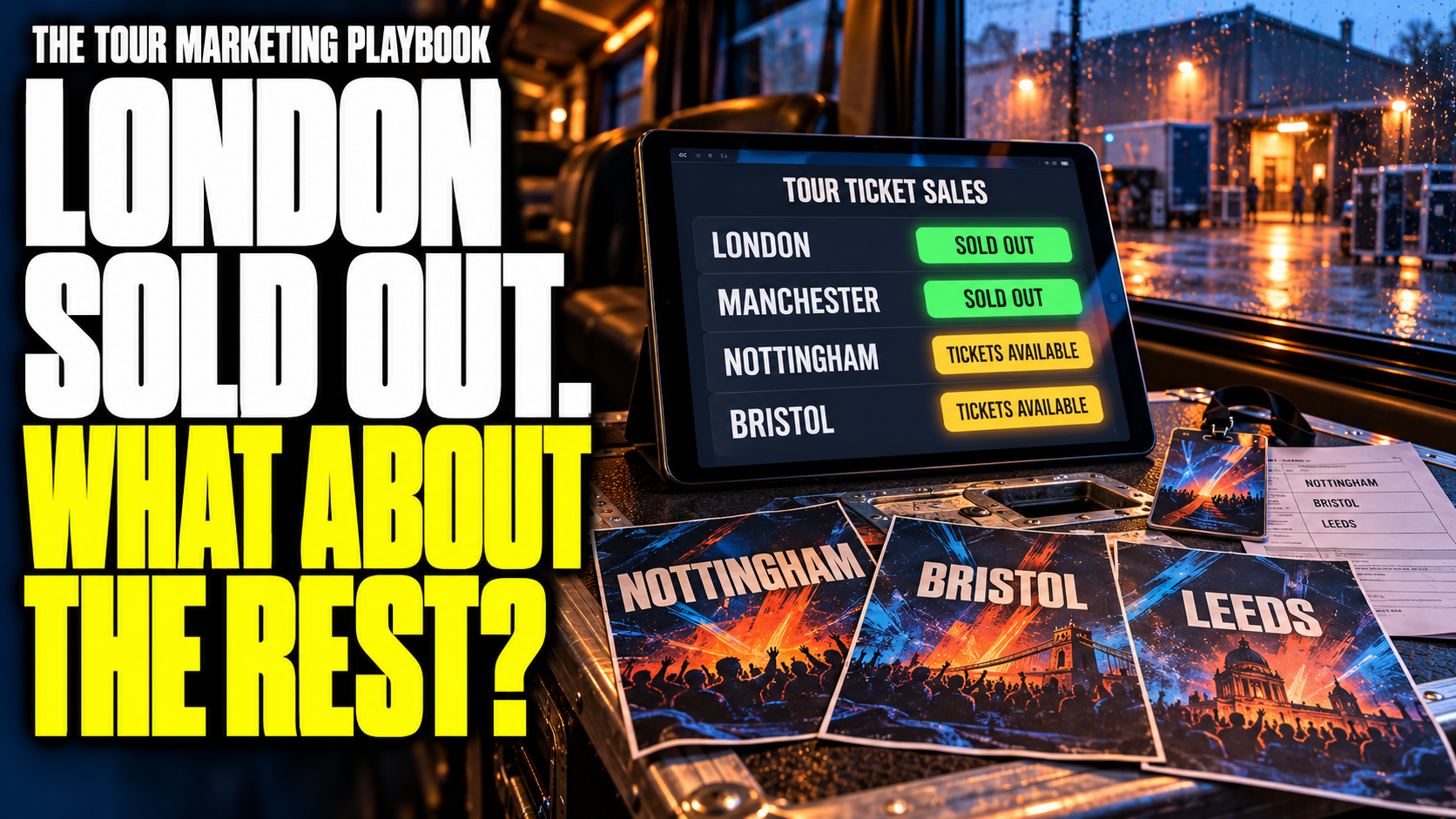
- A tour is ten local campaigns sharing a poster, not one campaign with ten dates on it. Run it as one and the strong markets carry the total while hiding the cities nobody spoke to. So: one loud announce, then per-city journeys from day one.
- Decide the sequencing first. Everything at once buys one national moment; anchors first banks sellout news that sells the rest. Both work. Drifting between them does not.
- Run presale registration per city, cap allocations so scarcity stays real, and publish the all-in price everywhere. Since April 2025 the UK regulator can fine you directly for hidden fees and fake scarcity alike.
- Judge each date against your own pace at that lead time, never the tour total. When one slips, climb the ladder: content, local voices, targeted reminder, a real price deadline, and only then anything discount-shaped.
- Tag every buyer and registrant by date, and settle who gets the promoter's buyer data before the on-sale: the compounding asset most tour teams never build.
The problem: one announce, ten cities, three of them heard it
You know the Tuesday. The poster went up, one email went to the whole national list, and the link in the artist's bio dropped every fan on a page listing ten dates in a column. London moved that afternoon. Manchester moved by Friday. After that, quietly, not much did. Six weeks later someone asks why Nottingham is at 40 per cent, and the honest answer, if anyone says it out loud, is that nobody ever spoke to Nottingham.
Two numbers explain most of it. Median Instagram engagement is 0.30 per cent of followers per post, down from 0.36 the year before (Rival IQ, 2026). That is a brand-account median and artists usually do better, so be generous and call it five times that. A 40,000-follower artist's announce then earns about 600 engagements, and engagements are not people: a fan who likes and comments counts twice. Across ten dates, sixty a city, mostly from fans who were always going to buy. More people see a post than touch it, but seeing ten dates is not being asked to one.
Then the clock. On Eventbrite's US music events in early 2024, a mix with plenty of club nights in it, 57 per cent of tickets sold a week or less before the show. The fan in Nottingham decides late, but on a relationship built, or never built, in the weeks before. A final-week reminder only works if it lands on a Nottingham list that already exists, and you are about to need ten of them.
A tour, then, is ten local campaigns that share an artist, a poster and a routing. Where this says "the artist", read the act on the poster, which may well be you.
Below, we rerun that tour properly: same artist, same ten dates, same Nottingham. It is a composite, invented to show the shape rather than taken from any real campaign or our data, but every move in it is one you could make on Monday.
Why listen to us
We build the ticketing, CRM, links and reminder sends these campaigns run on, for labels, promoters, artists and agencies, so we watch ten-city on-sales break in the same few places: totals hiding soft cities, generic links bleeding buyers, discounts pulled a fortnight early. Every move below works without us, on five subscriptions: an email tool with decent segmenting, a link tool, a ticketing platform, a spreadsheet and a shared doc. Every dated figure carries a source at the end.
The system: six moves that make a multi-city on-sale compound
Each move opens with the answer, then names the habit it replaces. Whoever runs the campaign, the audience is the artist's, so every email, reminder and reply reads in the artist's voice. The engine room stays invisible.
1. Should you announce every city at once, or anchor cities first?
Announce everything at once when you have one big national moment worth spending; announce anchor cities first when demand is spiky and a sellout story is within reach. It is the biggest call in the whole tour announcement strategy, so make it before a single asset is briefed.
The habit it replaces: half-announcing, half-boosting, and never actually deciding.
An anchor city is the market where the artist's demand is strongest, announced first and sized to sell out fast so the sellout markets every other date. Anchors first means selling two or three clean, then announcing the full routing with "London and Manchester sold out in 48 hours" on every asset. Proven scarcity is the most honest advertising there is; it costs complexity, a longer campaign and the risk that an anchor stalls. All at once buys momentum and simplicity instead.
Five questions decide it:
- Where is demand, really? Spotify for Artists' top cities, past ticket sales, merch shipping addresses. Two or three cities holding most of the heat favours anchors.
- Is a fast sellout plausible? Be cold about it: right-sized room, warm local base, realistic price. An anchor that takes five weeks banks nothing.
- Does the routing allow it? Some promoter and venue contracts require simultaneous announces. Check first.
- Is there a national moment on the table? A radio premiere, a big support slot, a release week. One simultaneous announce spends it best.
- What does the weakest market need? Proof the tour is an event, or simply time. If it is a cold market, it needs its own plan.
The respectable hybrid announces every date at once, then puts the first fortnight of spend behind the strongest markets. What you must not do is drift.
Cold markets are a different campaign. Music Venue Trust's 2025 annual report found that 175 UK towns and cities with a grassroots venue no longer get regular touring shows by professional artists, and that 59 per cent of grassroots venues saw no major promoter activity at all. A city nothing has toured lately has lost the habit of going. Give it a local support act who draws there, the venue's own list and socials, a room it can sell out, and the longest runway the sequencing allows.
Nottingham, at the planning stage. Spotify's top cities and the last tour's sales put the heat in London and Manchester, so the composite goes anchors first: those two announce a week early, in rooms sized to go fast. Nottingham, unplayed for three years, is the coldest market on the routing. Its support slot goes to a local act with a real following, held back until the headline news fades.
2. Announce architecture: one loud moment, then per-city journeys from day one
The right structure is a single national announce for momentum, with per-city journeys switched on the same day rather than bolted on when a market goes soft. The announce is a firework; the per-city journeys are the fire.
The habit it replaces: one announce email to the whole national list, where a fan in Glasgow finds their date on the ninth line of a table.
The national layer (trailer, press, socials, one full-list email) carries the news. It cannot convert a fan in Bristol, who needs Bristol's date, room, support and price. The city layer does: from announce day, a Manchester fan never gets a message where Manchester is not the headline.
A working timeline for a club-and-theatre level tour, where T is the first show and the announce lands about ten weeks before it. Compress or stretch it to your routing; keep the shape.
| When | What happens |
|---|---|
| T minus 12 weeks | Routing locked. Sequencing decided (move 1). City segments built. Per-city targets set from capacity and past campaigns. Creative briefed. Registration page ready. A listing per date, scheduled to publish at the announce minute. |
| T minus 10 weeks: announce day, early in the week | Trailer, poster, press, socials, full-list email. Presale registration opens, asking each fan which city is theirs. |
| Until the night before presale | Registration runs: three days if you announce in the on-sale week, a week if you announce the week before and want a fuller read on demand. |
| Presale, Thursday | Presale opens city by city to registrants and the list. |
| General on-sale, Friday 10am local | Per-city emails lead with that city's date and link. Local press and promoter channels fire. |
| Every week until each show | Scorecard review (move 5), one city-relevant beat per market, supports announced city by city. |
| Final 2 weeks per date | Reminder ladder to that city's segment, honest availability only. |
| Show week and after | Door capture, then a per-city thank-you within 72 hours (move 6). |
That is the all-at-once shape; anchors first adds a phase in front, with the anchor dates on sale a week or two early and the full routing carrying their sellout news. A fixed on-sale moment is itself a marketing beat. And stagger the supports: one announced in week three gives that city fresh news just as the buzz fades.
Nottingham, announce day. The full routing goes out with "London and Manchester sold out in 48 hours" on every asset, and Nottingham's segment gets its own email that morning: its date, its room, its all-in price and "first Nottingham headline show in three years", with none of the other nine.
3. Geo everything: Manchester fans should hear about Manchester
Geo-targeted marketing for a tour means three things: city-segmented lists, a link strategy that lands each fan on their nearest date, and per-city creative with local hooks. Do all three or the other two leak.
The habits it replaces: one link that makes every fan scroll a national table, and identical creative everywhere, so the Leeds fan sees nothing that says Leeds.
City segments. Before announce day, split the artist's list by location: past ticket purchases, merch shipping addresses, sign-up forms that asked, and for everyone else a one-question "which show is yours?" email that doubles as announce warm-up. Two shortcuts beat asking. The date is the city, so tag every buyer with the show they bought and the segment builds itself. And a fan who registered through Bristol's link is a Bristol contact without answering a thing.
The link strategy. A tour link is one URL for the whole run: a page listing every date in order, each with its city in plain sight. Known city, direct link to that date. Unknown or mixed, which is the poster, the bio and press: the tour link. Every fan you can place is one tap from their own date.
Most tours forget a third kind: one Bandsintown listing per date, ticket link attached, scheduled to publish at the announce minute, because a date published early goes out to the feeds (and, with Notify My Followers on, to your followers) before the news. Bandsintown documents pushing each date to Spotify, Apple Music and Maps, YouTube, Google Search, Shazam and Amazon Music, in front of people who already listen and never see your posts. (Songkick is the alternative; Bandsintown is the one that publishes where the dates land.) Sync takes up to 48 hours.
Per-city creative. One master set with swappable local elements, not ten campaigns:
- The city name, large, in the artwork variant. Obvious, and still skipped constantly.
- The local support billing, led with in that city. A support act's own following is free local reach.
- A local hook: the last time the artist played this room, "first Bristol headline show in three years".
- The venue's access route. Venues handle accessible and companion tickets differently, some only through their own box office, so confirm it per city: it is the first question disabled fans ask.
- Local voices: the promoter, supports, resident DJs, the venue's channels, each asked for one specific share on a specific day.
On the same Rival IQ benchmark TikTok's median is 2.01 per cent against Instagram's 0.30, so cut the city variant as video before you cut it as a poster. And make the announce post a capture surface: a comment keyword that DMs back that city's link builds the segment where the reach is.
The test for every asset: would a fan in this city, seeing it for two seconds, know the show is for them?
Nottingham's variant puts NOTTINGHAM in the biggest type on the artwork, leads with "first Nottingham headline show in three years" and carries the venue's companion-ticket route. Everything else is the master set.
Shortcut: in SoundOps each date gets its own event link with a QR code and per-link analytics, a bio page or the artist's own page lists the routing (the artist page shows every upcoming date), and every capture carries the tag of the link it came from, so Bristol's registrations are a saved search, not an export. An automation step can also stamp a buyer's city from the venue, so segments fill themselves.
4. Presale mechanics that work across ten markets
A presale is an early-access window before the general on-sale; presale registration is the sign-up that grants access. Run registration per city, cap allocations so scarcity stays real, and treat the registration list as the prize.
The habit it replaces: one national presale with no per-city thinking, which the strong markets eat while the soft ones learn nothing.
Registration and allocations. Open registration the moment you announce, keep it open until the night before presale, and ask one extra question: which city. That field builds your geo-segments for free and shows where demand is before a ticket sells. Then cap the presale. An allocation is the number of tickets released in a given window or tier; set the presale's at around 30 to 50 per cent of sellable capacity per date, tuned to each city's registrations, so your strongest city cannot sell out quietly before the public gets a look.
Honest scarcity. Scarcity works because it is information, and it stops working for good the first time a fan catches you lying. Tier caps are real, deadlines fire, "selling fast" appears only when true, and nobody announces a sellout that has not happened. In the UK that is also the law, and the law now has teeth.
The legal bit (UK, as of September 2026). Falsely claiming that something is available only for a limited time has been a banned practice since 2008, and the Digital Markets, Competition and Consumers Act 2024 carried the ban forward and widened it. What changed on 6 April 2025 is enforcement: the CMA can now fine a business directly, up to the higher of £300,000 or 10 per cent of global turnover. Its own example is a countdown that restarts at zero. The Act also made the all-in price explicit: every unavoidable fee included the first time a price is shown, on the email, the poster, the ad and the "first price ends Friday" post, not just at checkout. "From £25" that becomes £29.50 at the end is unlawful.
For tiered pricing, copy what the biggest ticketer signed. On 25 September 2025 the CMA announced the undertakings Ticketmaster gave to close its Oasis on-sale investigation: 24 hours' notice of tiered pricing, the price range shown to fans entering the queue, word when the cheaper tier sells out, and no labels implying a benefit a ticket does not carry. It found no dynamic pricing. The harm was that queuing fans were never told there were two standing prices, and that some "platinum" tickets sold at almost two and a half times the standard price with nothing extra attached.
Resale is heading the same way, slowly. The government committed in November 2025 to making resale above face value unlawful, but the 13 May 2026 King's Speech promised only a draft Ticket Tout Ban Bill, and none has been introduced as of September 2026. In the United States, resale is regulated state by state.
When a date genuinely sells out. Run a waitlist and, where your ticketing supports it, face-value fan-to-fan resale. That is hardly fringe: Ticketmaster's UK managing director says the company capped resale on its own platform at face value in 2018. The best-documented UK case of going further is Ed Sheeran's 2018 stadium tour. His promoters warned that touted tickets would be cancelled, then cancelled around 10,000 and resold them at face value through Twickets, the only authorised route. By their count 90 per cent of tickets reached fans at face value. The cost: some 500 fans with cancelled tickets were turned away at the first Manchester show, and Wembley needed six box office windows just to deal with them. A club-and-theatre tour needs only the cheap half.
The cheap half: cap tickets per order at four or six, because a tout clearing a 200-ticket tier at four an order needs fifty accounts and fifty cards, not two. Scam listings wearing the artist's photo appear under a sellout post within minutes, and it is the artist's name fans remember when they get burned. So name the one official route to spare tickets under that post, and report the waitlist as a number rather than a vibe: scarcity you can prove.
Nottingham's presale. Its registrations come in at about a third of Manchester's, so its allocation sits at 30 per cent rather than 50: no point manufacturing scarcity in the city least likely to believe it. The registration count is the first warning, and it arrives before a ticket has sold.
Shortcut: in SoundOps each date's event page takes "Notify me" signups until its first tier opens, with a separate, unticked news box, and a presale tier stays hidden until a fan opens its access-code link. Registrants get that code by email when the presale opens, then one email when general sale starts. A signup phase on the date's smart link joins the same list, or the date's waitlist after a sell-out, but that form also signs fans up to your emails, so a registration that promises only the presale belongs on the event page. Tiers take real quantity caps with sequential release, or a clock: one carrying an on-sale date refuses to sell before it, which is the deadline doing the work.
5. Mid-campaign: read the pace weekly, then move the effort
Once a week, per city, compare tickets sold against a weekly target and against your own past campaigns, then move budget and effort toward the cities that respond. Thirty minutes of admin replaces every "how's the tour doing?" conversation with a decision.
The habit it replaces: judging the tour by its total. "The tour is 65 per cent sold" usually means three cities are nearly clean and three are quietly dying.
On a promoted tour the promoter holds the dashboard and usually the budget, so settle at deal stage how often counts arrive, what they include and who runs per-city spend. A scorecard you cannot fill is a meeting, not a system.
The scorecard, per date:
| Field | What it tells you |
|---|---|
| City and date | Which date, and how many days are left. |
| Sellable capacity | The real target after holds, guest list and production kills. |
| Total sold and sell-through | Where the date stands. |
| Sold this week | Direction of travel. A 70 per cent date selling zero is a problem; a 45 per cent date selling briskly is not. |
| Demand signals | Registrations, waitlist joins, RSVPs: the only column that moves before tickets do, separating an uninterested city from an undecided one. |
| Weekly target | Remaining tickets divided by weeks remaining. On pace, or behind. |
| Pace vs your own average | This date against your past campaigns at similar rooms and lead times. |
| Spend and cost per ticket | What each channel is buying you. |
| Next action | One committed line. A scorecard without actions is a mood board. |
Pace against your own average matters more than any absolute number, because tour sales are not linear. If your shows typically sit at 50 per cent a month out before the final-week surge, a date at 48 per cent is fine and a date at 25 per cent is on fire. Build that baseline from your history, even roughly.
Shortcut: SoundOps events analytics never rolls a routing up into one number. Each date is its own row: sell-through, tier velocity, new against returning buyers, and which tagged link sold each ticket, read against how your own shows sell at that lead time rather than an industry curve. Dates drifting behind that line are flagged while there is still time to act.
Moving the money. Paid social follows the same rule: spend on the gap, not the size of the city. A London date that sold out on presale needs nothing; a date forty-odd tickets behind its line needs most of the week's budget. Target a radius around the venue. Start with the warmest people, that city's registrants who never bought and visitors to that date's page, consent permitting, then widen to lookalikes of its past buyers. Judge each city on cost per ticket through its tagged links, not clicks.
The soft-city intervention ladder. When a date falls behind its own line, climb this in order. Each rung is cheaper and less damaging than the one below it.
The habit it replaces: reaching for a discount the moment a city goes soft, which trains fans to wait and insults everyone who paid full price.
- Content push. A fresh, local reason to care: the support billing led hard, a venue story, a clip addressed to the city by name. Most "soft" cities were never actually spoken to.
- Local voices. The supports, the promoter, resident DJs, the venue, the region's BBC Introducing show, local press and community pages, each with a specific ask on a specific day. Borrowed local trust converts better than anything you can buy.
- Targeted reminder. Email plus SMS to that city's segment only, starting with the registrants who never bought: date, room, support, a real reason to decide now. Check the consent rules for the market you are texting; the US TCPA is far harsher than UK PECR.
- A real price deadline. A tier deadline, published and kept: "first price ends Friday", at the all-in price. A price rise is scarcity with integrity; it rewards deciding rather than punishing early buyers.
- Only then, anything discount-shaped. Keep it quiet, targeted and dressed as added value: a plus-one upgrade, a group-of-four rate, a ticket-and-merch bundle to the local segment. Never a public percentage off, which tells early buyers they were mugs and teaches the market to wait next tour.
Nottingham, week three. The scorecard has it at 40 per cent with seven weeks to go, selling six tickets a week, against the roughly 50 per cent the artist's shows usually hold at that lead time. Same number as last tour, three weeks earlier, and this time someone is looking. Rung 1: a clip of the artist talking to Nottingham by name. Rung 2: the local support announcement, held back for exactly this. Rung 3: a reminder to the registrants who never bought. Rungs 4 and 5 are never needed. Meanwhile Manchester's waitlist passes a few hundred, and a second Manchester date goes up in week five as the consequence of the sellout.
6. Capture per market: make the next tour cheaper than this one
Tag every ticket buyer and every presale registrant by date, so the next tour announces to a warm local base instead of paying to find the same people twice. A registrant carries over only if the signup form asked, in a separate box, to send them more. This is what separates a tour from a touring career.
The habit it replaces: assuming the buyer data will reach you. It only does if somebody negotiated it, months before the on-sale.
The mechanics are small:
- Every buyer is tagged with the show they bought. If your ticketing feeds a CRM this is free; if not, export weekly and tag by hand until it hurts enough to fix it.
- Every registrant is tagged with the city they registered for, especially the ones who never bought. Those who ticked a separate news box on the form are the first names on the next presale list; registering for this presale is not consent to hear about the next one.
- Within 72 hours of each show, a thank-you goes to that city's attendees in the artist's voice: a photo from the night, a line that could only be about that room, first word on what is next. Email returns around £41 for every £1 spent on the DMA's 2026 tracker of UK marketers, a figure marketers estimate rather than measure, and this is the warmest send in the calendar.
- The data lives with the artist: consent captured properly, a working preference centre, and no lists quietly shared across a roster.
Whether any of it reaches the artist is settled before the on-sale, not after it. The fan relationship is contractual, not automatic. Eventbrite's data processing terms make the organiser the controller of the personal data of everyone who registers or buys; Ticketmaster's privacy policy lets it share buyer data with "Event Partners", which it lists as the artist, promoter, record label or venue. What reaches the artist depends on the platform's deal with the promoter, the promoter's deal with the artist, and what fans agreed to at checkout, and several links down that chain artists routinely end up with nothing. Name the artist as a consent recipient and write the export cadence into the promoter deal, before the announce.
The US is further along. The independent agents' body NITO has drafted a Data Share Agreement for members to put to promoters, and the Department of Justice's proposed March 2026 settlement with Live Nation includes a clause that would oblige it to tell an artist, on request, who bought tickets to their shows. The court has yet to approve it, and UK artists have no equivalent right. Borrow NITO's idea instead: a one-page data clause you bring to every promoter conversation.
Nottingham, after the show. It finished at 92 per cent without a discount. The thank-you went out two days later, and the next tour will announce to around 450 Nottingham buyers and registrants who ticked the news box before a penny of ad spend. The first week sets the story the rest of a campaign tells, and a few hundred warm names per city is what changes it.
The printable version
The PDF adds the announce-to-show timeline as a planner for your routing, a sequencing worksheet, a per-city brief, a presale allocation reckoner, the weekly per-city scorecard, the soft-city ladder as a diagram, one ten-date tour worked start to finish, and the condensed checklist to print.
Where SoundOps fits
Every move above works without us. SoundOps is the one place instead:
- City segments. Dynamic segments with lifecycle stages in the CRM, so "Manchester, past buyer or registrant" is a saved audience, not a Sunday of exports.
- A link per date, and one for the run, with a ready-tagged link per placement, artist repost and collaborator post included, one per act on the bill, and A/B testing on your emails.
- Ticketing and the price ladder. Tier deadlines as settings rather than diary notes, group tickets and discount codes for one city's segment, refund windows, a per-order limit, sold-out waitlists and face-value-only fan resale.
- Sends to one city. One campaign to one segment across email, SMS and WhatsApp, with any quiet hours and frequency caps you set enforced, and the post-show thank-you as a preset firing on each show's own dates.
- Events analytics. Move 5's scorecard per date rather than per tour, and across a roster, which artists actually pull, and where.
- The CRM, and who can see it. Consent recorded at purchase, check-in stamping who actually came, a preference centre and an immutable consent history on every contact, and team roles so a tour manager sees exactly what you allow.
And the gaps. We do not buy or run the ads, so the budget moves in move 5 still happen inside Meta and Google. There is no marketplace attached, so it sells to the audience you bring, not to strangers browsing for something to do. The pace benchmark needs two finished ticketed shows before it has an average, and counts only on-platform sales. And a buyer's city is recorded only when checkout collects it, turns a UK postcode into its post town (marked approximate), or the automation stamps it from the venue.
Money goes through your own Stripe account, not held by us, with a platform fee of 1 to 2.5 per cent by plan on top of your own Stripe processing, and no per-ticket SaaS fee. On a £20 ticket paid by a standard UK card that is 70p to £1 all in, depending on plan, against £1.98 on Eventbrite UK and £2.27 on Skiddle, whoever ends up paying those. DICE, See Tickets and Ticketmaster publish no rate card.
Every core feature is on every plan, from £19 a month; what changes between tiers is usage limits, the platform fee and a few pro extras. There is a 14-day free trial on Starter and a 14-day money-back guarantee on your first subscription payment.
Frequently asked questions
How far in advance should a multi-city tour go on sale?
Roughly eight to twelve weeks before the first date at club and theatre level, with the announce a few days to a week ahead of the on-sale. That is deliberately longer than the trend: one show survives a short runway, but ten cities cannot, because segments, registration and staggered supports all take weeks.
Does anchoring cities first work for a first headline tour?
Rarely. It pays only where a fast sellout is plausible, which wants a right-sized room, a warm local base and a realistic price, and a first headline run rarely has all three. Announce everything at once and weight the early spend toward your strongest markets instead.
Is presale registration worth it for a small tour?
Yes, at almost any size. It costs a form and one extra question, measures demand city by city before you spend a penny, and leaves a warm list of registrants who never bought: the first people to reach if a date goes soft.
How many assets does a ten-city campaign actually need?
One master set with swappable local elements: a city-name artwork variant, the local support billing, one local hook and that venue's access route. Then one email sequence duplicated per segment with the date and link swapped. The thinking happens once; only the local details change.
What should you do when one city is not selling?
Climb the ladder in order: a city-specific content push, then local voices, then a targeted reminder to that city only, starting with registrants who never bought, then a real published price deadline. Only after those four consider anything discount-shaped, quiet and dressed as value, never a public percentage off. And check the diagnosis first: many "soft" cities are on a normal curve for that lead time.
Should you discount tickets to fix a slow tour date?
As the last resort, not the first move. Early public discounts punish the fans who bought at full price and teach the whole market to wait next time. A tier price deadline gives the same urgency with integrity. If a quiet offer becomes unavoidable, target it to that city's segment as a bundle, plus-one or group rate, so face value stays intact in public.
When should you add a second date in a city?
When the first is on course to sell out with lead time remaining, waitlist demand is visible, and the routing allows it. Announce the sellout, let it breathe, then announce the second date as its consequence. "Second date added by demand" both sells hard and is true.
Will the UK ticket resale ban affect your on-sale?
Not yet. The government committed in November 2025 to making resale above face value unlawful, but the May 2026 King's Speech promised only a draft bill, and none has been introduced as of September 2026. Cap tickets per order and offer a waitlist with face-value resale anyway: the reform would also stop anyone reselling more tickets than they were entitled to buy.
How do you keep ticket buyers for the next tour?
Sell through a system that lands every buyer in a database the artist controls, tagged by date and event with proper consent, rather than a marketplace that keeps the relationship. On a promoted tour that starts in the deal: name the artist as a consent recipient at the promoter's checkout and agree the export cadence before the announce. Add presale registrants, and thank each city within days of the show. (In SoundOps, purchase and check-in tag the contact automatically and the thank-you is a preset.)
Know someone who needs this?
Send them the playbook. It is free to read, no signup needed.